

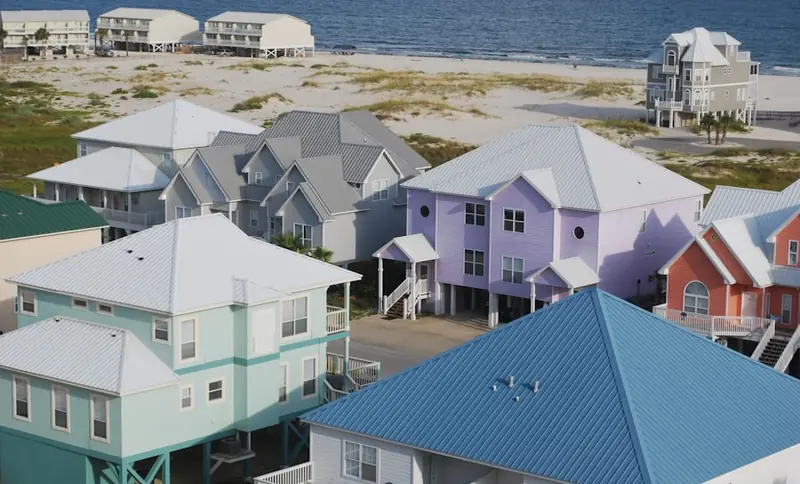
The Alabama Gulf Coast — primarily Gulf Shores and Orange Beach — is one of the Southeast’s most active short-term rental markets. The combination of white sand beaches, a concentrated tourism season, high repeat visitor rates, and relatively accessible entry prices compared to Florida’s Gulf Coast has made this corridor a consistent target for investors pursuing vacation rental income.
This overview covers how the market works, what the numbers look like, what the risks are, and what you need to know before buying.
Why the Gulf Shores / Orange Beach Short-Term Rental Market Exists
The fundamental driver is geography. Alabama has approximately 32 miles of Gulf-front coastline — a narrow corridor shared primarily by Gulf Shores and Orange Beach. That scarcity, combined with consistent demand from a large regional population in the Southeast, creates a compressed, high-demand tourism market with meaningful income potential for property owners.
Key demand factors:
- Drive-market proximity. Gulf Shores is within 4–5 hours of Birmingham and Jackson, approximately 6 hours from Atlanta, and within 7–8 hours of Nashville and Memphis. The overwhelming majority of visitors drive rather than fly, placing the Alabama Gulf Coast within a day’s drive of tens of millions of Southeast residents — which reduces price sensitivity compared to destinations that require airfare.
- Repeat-visit leisure destination. Calm Gulf waters, wide beaches, and a vacation atmosphere oriented toward group and leisure travel create strong repeat visitor patterns. Visitors who come once often return annually.
- Cost advantage over Florida. Compared to 30A, Destin, Panama City Beach, and other Florida Gulf Coast destinations, Gulf Shores and Orange Beach offer competitive pricing for visitors — and for investors, entry prices are typically lower.
Seasonal Structure
The Gulf Shores/Orange Beach short-term rental market operates on a pronounced three-season structure:
Peak Season (June – August)
The core of the rental year. Summer school schedules drive concentrated family vacation demand into an approximately 12–13 week window. Occupancy rates on well-managed properties regularly approach 90–100% during this period. Weekly rates for beachfront and Gulf-view properties can range from $3,000 to $10,000+ depending on property size, location, and amenities.
Peak season generates a disproportionate share of annual income. Many operators see 50–60% of annual gross revenue in the three summer months.
Shoulder Season (March – May and September – October)
The shoulder periods bookend peak season. Spring break (typically mid-March through early April) is a strong demand spike within the shoulder period. September and October bring fall travelers — often couples, anglers, and retirees — who find the reduced crowds and comfortable temperatures appealing.
Occupancy is lower than peak but meaningfully above off-season. Weekly rates typically run 60–75% of peak season rates. A well-positioned property can be productively booked through most of the shoulder period, particularly during spring break weeks.
Off-Season (November – February)
Demand drops substantially after mid-October and remains low through February. Occupancy is typically 30–50% of available weeks, concentrated on holidays (Thanksgiving, Christmas/New Year’s) and occasional long-weekend bookings.
Weekly rates during the off-season typically run 40–50% of peak rates. Many owners take properties off rental platforms during part of the off-season for personal use or maintenance.
Income Potential: What the Numbers Look Like
Income varies enormously based on property type, location, size, amenities, proximity to the Gulf, and management quality. General ranges for modestly conservative underwriting:
Beachfront / Gulf-front condos (2BR)
- Peak season (12 weeks): $2,500–$4,500/week = $30,000–$54,000
- Shoulder (16 weeks at 65% rate and 70% occupancy): ~$18,000–$28,000
- Off-season (8 weeks at 45% rate and 40% occupancy): ~$3,600–$7,500
- Annual gross estimate: $50,000–$90,000+ (varies significantly with platform performance)
Inland / canal-access single-family homes (3–4BR)
- Income potential is lower than Gulf-front but costs are also lower
- Annual gross typically ranges $35,000–$65,000 for well-managed properties
- Larger homes with pools and premium amenities can exceed this range
These are illustrative ranges, not guarantees. Actual results depend heavily on listing quality, pricing strategy, management, amenity set, and the property’s platform ratings history.
Use the Investment Property Analyzer to model income projections against specific purchase prices and expense stacks.
Operating Costs: The Full Picture
short-term rental operating costs in Gulf Shores/Orange Beach are higher than long-term rental operating costs. Common cost categories:
Management fees: Full-service vacation rental management typically runs 20–30% of gross revenue. This covers listing management, guest communications, check-in coordination, housekeeping, and maintenance dispatch. Self-management is possible but requires active hands-on involvement — feasible for owners who live nearby, impractical for most out-of-state investors.
Platform fees: Airbnb and VRBO each charge fees on bookings. Airbnb charges hosts approximately 3% of the booking subtotal. VRBO fee structures vary by subscription model. Platform fees are relatively small individually but add up across a rental calendar.
Cleaning and turnover: Budget $100–$200 per booking depending on property size. High-turnover weeks in peak season mean multiple cleaning charges per week.
Supplies and consumables: Toiletries, paper goods, kitchen supplies, linens. Budget several hundred to over a thousand dollars per year depending on bookings.
Insurance: See the Insurance section below — this is one of the most significant cost variables in Gulf Coast short-term rental underwriting.
HOA fees: Many Gulf-front condo buildings and communities carry HOA fees that can run $400–$1,200+/month. HOA fees must be factored into the expense stack — they are not optional. Some HOAs also regulate or restrict short-term rentals. Verify HOA rules before purchasing.
Furnishing replacement reserve: Vacation rental furnishings experience accelerated wear. Budget an annual reserve for replacement of furniture, appliances, linens, and decor.
Property taxes: Gulf-front and canal-access properties carry higher assessed values and corresponding tax bills. Verify current assessed values with the Baldwin County Revenue Commissioner.
Insurance: The Critical Variable
Insurance is the most significant and volatile operating cost in Gulf Coast short-term rental underwriting, and the one most commonly underestimated by first-time investors.
Homeowner’s / dwelling insurance: Gulf Coast rates have increased substantially in recent years following a series of significant storm events across the Gulf of Mexico and Florida. Expect rates for Gulf-front properties to be significantly higher than inland Alabama. Always obtain actual quotes — do not estimate from national averages.
Flood insurance: The barrier island geography of Gulf Shores and Orange Beach means many properties sit in FEMA flood zone AE or VE. Flood insurance is required by lenders on properties in these zones. Verify flood zone status at msc.fema.gov for any specific property. Elevation certificates can meaningfully affect flood insurance premiums — properties elevated above the Base Flood Elevation pay lower rates.
Wind/hurricane coverage: Wind coverage is often a separate policy from standard homeowner’s insurance on Gulf Coast properties, or it may be excluded entirely from the HO policy. A Gulf-front or Gulf-view property without wind coverage is significantly underinsured. Confirm exactly what is and is not covered before closing.
Short-term rental endorsement: Confirm that your insurance policy covers the property when operated as a short-term rental. Standard homeowner’s policies may not cover commercial-use activity. Some carriers offer specific vacation rental policies; some short-term rental platforms provide supplemental coverage, but that coverage has limits and conditions.
Get actual quotes for all insurance types before making an offer on any Gulf Coast short-term rental property. Insurance costs can materially affect whether a deal cash flows.
Permit Requirements and Regulatory Environment
This is a required step, not optional.
Gulf Shores and Orange Beach both regulate short-term rentals, and the rules can change. Before purchasing any property with short-term rental intent:
Verify whether the specific property and zone permit short-term rental operation. Not all areas of Gulf Shores and Orange Beach allow short-term rentals. Some zones, neighborhoods, and HOAs restrict or prohibit them.
Obtain the required business license and rental permit. Both Gulf Shores and Orange Beach require short-term rental operators to obtain a business license and pay lodging taxes. Failure to comply exposes the operator to fines and potential loss of operating ability.
Understand lodging tax obligations. Alabama levies state lodging tax; both Gulf Shores and Orange Beach levy local lodging taxes. Airbnb and VRBO collect and remit these taxes in many cases, but the owner is ultimately responsible for compliance. Confirm current requirements with each city.
Contact the cities directly for current requirements:
- City of Gulf Shores: gulfshoresal.gov
- City of Orange Beach: cityoforangebeach.com
Regulations in this space have been evolving. Requirements that applied when this guide was written may have changed. Always verify with the city before purchasing.
Platform Dynamics
Most Gulf Coast vacation rental bookings happen through two dominant platforms: Airbnb and VRBO (owned by Expedia Group). Each has a different user base, fee structure, and booking dynamic.
VRBO has historically dominated the Gulf Coast vacation rental market, particularly for full-home rentals with families. It attracts a higher proportion of week-long bookings from repeat beach vacation visitors.
Airbnb has a broader user base and typically generates more search volume. It tends to perform better for shorter stays and attracts a wider demographic range.
Most professionally managed properties are listed on both platforms. Cross-platform management tools (channel managers) handle availability synchronization to prevent double-bookings.
Platform ratings matter. A property’s review score and review volume significantly affect search ranking and booking conversion. New properties entering the market without review history are at a disadvantage and typically need to price below comparables to generate initial bookings and reviews. Factor this ramp-up period into your year-one income projections.
Self-Management vs. Professional Management
Professional management is the practical choice for most out-of-area investors. A full-service vacation rental manager handles listing creation and optimization, dynamic pricing, guest communication, check-in/check-out coordination, housekeeping, and maintenance dispatch. The cost — typically 20–30% of gross revenue — buys genuine operational delegation. For absentee owners, this is not a luxury, it is a necessity.
Self-management is feasible for owners who:
- Live within 30–60 minutes of the property
- Are willing to be genuinely available to guests
- Can coordinate cleaning crews and handle maintenance emergencies on short notice
Self-management eliminates the management fee and gives the owner direct control over the guest experience and pricing. It is a real job, not passive income. Owners who underestimate the operational demand of a high-turnover Gulf Coast rental consistently describe the experience as more intensive than anticipated.
If you plan to self-manage, spend time talking with current self-managing owners in the market before buying. The management burden during peak season — when you may have same-day turnovers — is materially different from the off-season.
BRRRR and Value-Add Strategies
The Gulf Coast short-term rental market is not a classic BRRRR market. Properties are generally priced to reflect their income potential — distressed properties with high ARV upside are less common here than in Mobile County or inland Baldwin County. That said, opportunities exist:
- Pre-renovation condos in established buildings: Older units in high-demand buildings can be acquired below peak-condition value, renovated, and repositioned for higher occupancy and rates.
- Properties with deferred maintenance: Homes that have been poorly managed or maintained can be acquired below market, renovated, and relaunched on platforms. Management quality improvements alone can significantly move revenue on underperforming properties.
- Off-market acquisitions: Properties inherited by out-of-state owners, estates, or sellers who haven’t updated their rental operation in years can sometimes be acquired below the market premium for well-performing STRs.
Any value-add short-term rental deal requires careful renovation cost underwriting and realistic income ramp-up assumptions. Use the MAO calculator in the Investment Property Analyzer before making offers on distressed properties.
Key Risks
Concentration risk. A Gulf Coast short-term rental portfolio is heavily exposed to a single market and a single seasonal demand pattern. A major hurricane, a significant market downturn, or a regulatory change can affect the entire portfolio simultaneously.
Hurricane and storm risk. Gulf-front and near-Gulf properties face direct exposure to storm damage. A single major hurricane can cause significant damage and extended rental downtime. Adequate insurance coverage is non-negotiable, but insurance doesn’t fully replace lost rental income during repairs.
Insurance market volatility. Gulf Coast property insurance rates have increased significantly and the market continues to evolve. Insurance cost increases can change the profitability calculus on deals underwritten under older rate assumptions.
Platform concentration. Heavy dependence on Airbnb or VRBO means exposure to platform policy changes, fee changes, or algorithm updates. Diversifying across both major platforms and maintaining direct booking relationships with repeat guests reduces this risk.
Market saturation. The Gulf Shores and Orange Beach short-term rental market has grown substantially. More supply competes for the same demand pool, particularly in the condo segment. Market-level occupancy and rate trends are worth monitoring before entering.
Regulatory risk. Short-term rental regulations are an active policy area in many beach communities. Changes to permitting requirements, zoning, or tax treatment can affect the operating environment.
Is the Gulf Coast Short-Term Rental Market Right for You?
The Gulf Coast short-term rental market is well-suited to investors who:
- Can tolerate the upfront capital requirement of coastal property pricing
- Have or can afford professional management
- Understand and have budgeted for the real insurance cost stack
- Have a long-enough time horizon to absorb a bad season or a significant weather event
- Have realistic income expectations based on conservative projections — not best-case scenarios
It is less well-suited to investors who:
- Need the property to cash flow significantly from day one
- Are underwriting to optimistic income assumptions without market verification
- Cannot absorb a major repair or prolonged vacancy without financial stress
- Are primarily motivated by personal vacation use and treating rental income as a bonus
Resources
- Investment Property Analyzer — model any Gulf Coast short-term rental deal with the built-in STR income module and full Gulf Coast expense stack
- STR Income Estimator — quick seasonal income projection before you run the full analyzer
- Investment Property Financing Guide — DSCR loans, portfolio loans, and conventional investment property financing
- Moving to Baldwin County — submarket-by-submarket context on Gulf Shores, Orange Beach, Foley, and the Eastern Shore
- Real Estate Glossary — definitions for investment terms used in this guide
- FEMA Flood Map Service Center: msc.fema.gov
- City of Gulf Shores: gulfshoresal.gov
- City of Orange Beach: cityoforangebeach.com
- Baldwin County Revenue Commissioner (property taxes): baldwincountyal.gov
Evaluating a Gulf Coast short-term rental property?
Run your numbers in the Investment Property Analyzer, then schedule a free investor consultation. I can walk through the deal with you — income assumptions, actual insurance costs for the specific property, HOA warrantability, permit status, and how to structure the offer.
Request an Investor ConsultationThis guide is provided for general informational and educational purposes only. It does not constitute financial, investment, legal, or tax advice. Income projections are illustrative only — actual results vary based on property characteristics, management quality, market conditions, and factors outside the investor’s control. Insurance cost information is general — always obtain actual quotes. Permit and regulatory requirements are subject to change — verify current requirements directly with the City of Gulf Shores and City of Orange Beach before purchasing. short-term rental regulations, platform policies, and tax requirements may have changed since publication. Consult a CPA and attorney before any investment decision.
Alabama Gulf Coast Guide | alabamagulfcoastguide.com | Milton Christ, REALTOR® | naf Cash Certified | Keller Williams Alabama Gulf Coast | AL License #172097